Neon#
References#
Equation of State#
M. Thol, R. Beckmüller, R. Weiss, A.H. Harvey, E.W. Lemmon, R.T. Jacobsen, and R. Span. Thermodynamic properties for neon for temperatures from the triple point to 700 k at pressures to 700 mpa. J. Phys. Chem Ref. Data, 2019, Submitted.Melting Line#
Ian H. Bell. Melting line correlation for neon. 2026. Polynomial-in-theta correlation, p = p_t [1 + sum_i a_i (T/T_t - 1)^t_i], fit to the solid-liquid (crystal phase C1) melting data evaluated in the NIST ThermoData Engine (Frenkel et al., J. Chem. Inf. Model. 45, 816 (2005)). The triple point (T_t = 24.556 K, p_t = 43.417 kPa) and the saturated-liquid molar volume are taken from the Thol et al. neon EOS (J. Phys. Chem. Ref. Data 48, 023101 (2019)) as implemented in CoolProp. The leading linear term is constrained so that the slope at the triple point matches the Clausius-Clapeyron value dp/dT = dS_fus/dV_fus = 6.28 MPa/K, using dH_fus = 335 J/mol and a solid density of 1.444 g/cm^3. The correlation reproduces the experimental melting temperatures to 0.97 K RMS (3.0 K maximum) over 24.6-328 K, and supersedes the prior fit that was high by roughly a factor of 16. Crystal phase: neon has a single solid phase (fcc, C1) along the melting line in this range, so no phase ambiguity arises.Surface Tension#
A. Mulero, I. Cachadiña, and M. I. Parra. Recommended Correlations for the Surface Tension of Common Fluids. J. Phys. Chem. Ref. Data, 41(4):043105–1:13, 2012. doi:10.1063/1.4768782.Aliases#
neon, NEON, R720
Molecular Structure#
Neon — 2D structure (interactive: click and drag to rotate)
Fluid Information#
Parameter, Value |
|
|---|---|
General |
|
Molar mass [kg/mol] |
0.020179 |
CAS number |
7440-01-9 |
ASHRAE class |
A1 |
Formula |
Ne |
Acentric factor |
-0.03549258024442481 |
InChI |
InChI=1S/Ne |
InChIKey |
GKAOGPIIYCISHV-UHFFFAOYSA-N |
SMILES |
[Ne] |
ChemSpider ID |
22377 |
Limits |
|
Maximum temperature [K] |
725.0 |
Maximum pressure [Pa] |
1000000000.0 |
Triple point |
|
Triple point temperature [K] |
24.560000000000002 |
Triple point pressure [Pa] |
43417.232458065846 |
Critical point |
|
Critical point temperature [K] |
44.39999970498691 |
Critical point density [kg/m3] |
486.31370002144575 |
Critical point density [mol/m3] |
24099.990089768857 |
Critical point pressure [Pa] |
2661630.706279463 |
REFPROP Validation Data#
Note
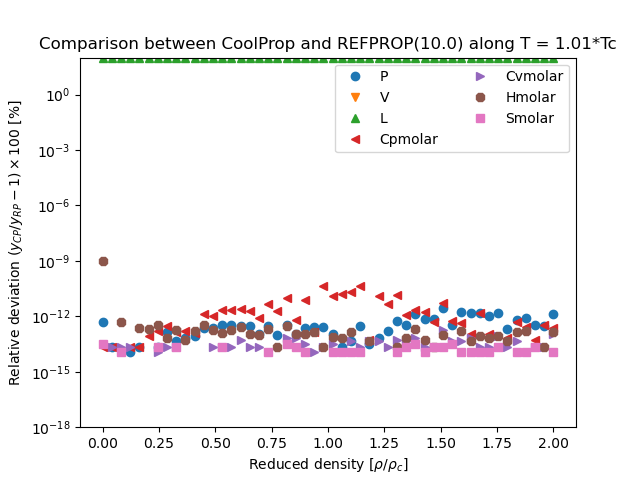
This figure compares the results generated from CoolProp and those generated from REFPROP. They are all results obtained in the form \(Y(T,\rho)\), where \(Y\) is the parameter of interest and which for all EOS is a direct evaluation of the EOS
You can download the script that generated the following figure here: (link to script), right-click the link and then save as… or the equivalent in your browser. You can also download this figure as a PDF.
Consistency Plots#
The following figure shows all the flash routines that are available for this fluid. A red + is a failure of the flash routine, a black dot is a success. Hopefully you will only see black dots. The red curve is the maximum temperature curve, and the blue curve is the melting line if one is available for the fluid.
In this figure, we start off with a state point given by T,P and then we calculate each of the other possible output pairs in turn, and then try to re-calculate T,P from the new input pair. If we don’t arrive back at the original T,P values, there is a problem in the flash routine in CoolProp. For more information on how these figures were generated, see CoolProp.Plots.ConsistencyPlots
Note
You can download the script that generated the following figure here: (link to script), right-click the link and then save as… or the equivalent in your browser. You can also download this figure as a PDF.
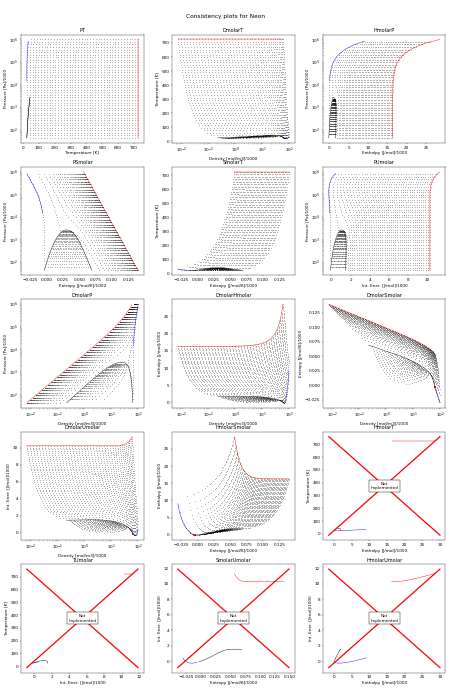
Flash consistency (HEOS): no failures.
Superancillary Plots#
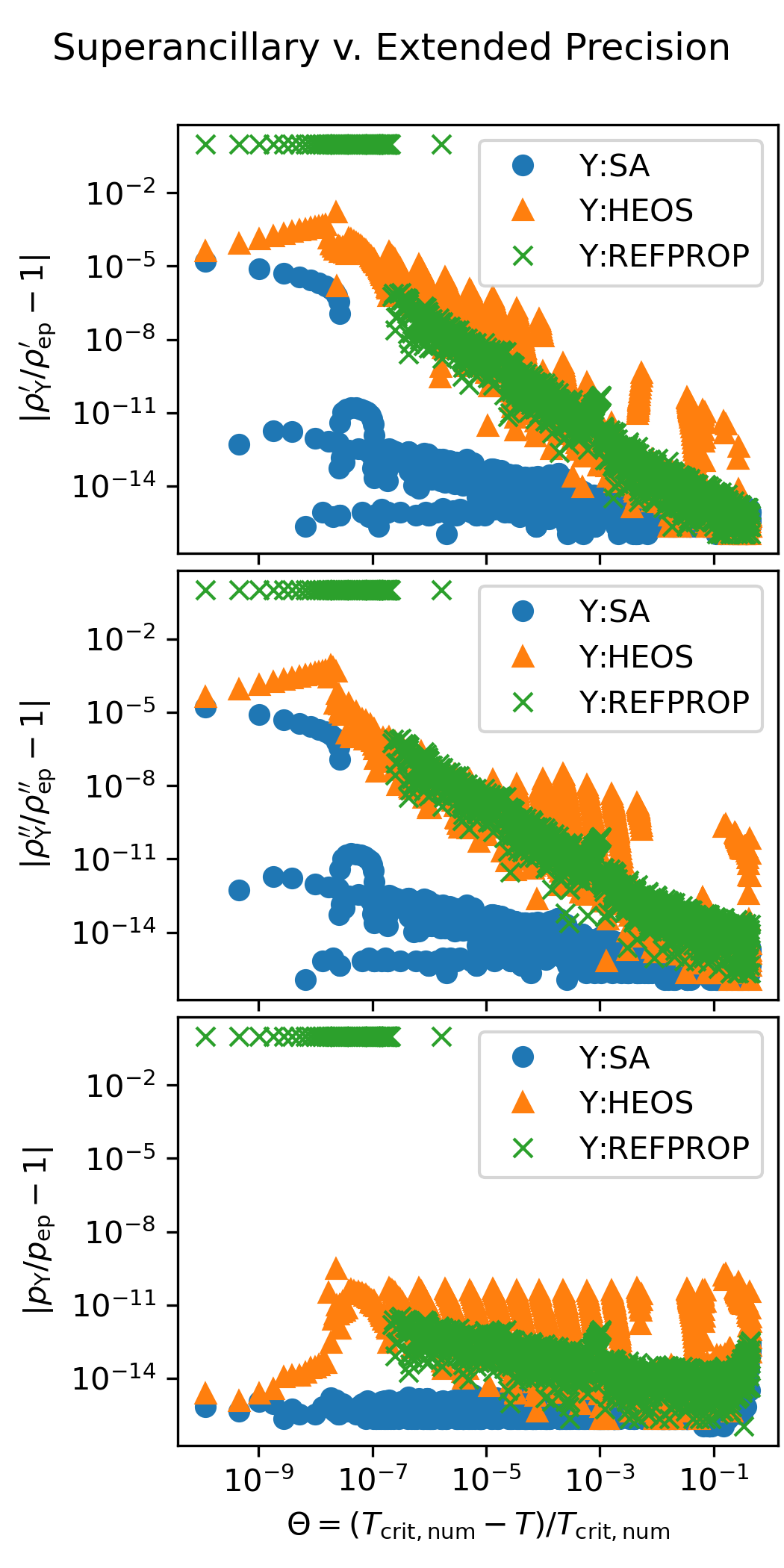
The following figure shows the accuracy of the superancillary functions relative to extended precision calculations carried out in C++ with the teqp library. The results of the iterative calculations with REFPROP and CoolProp are also shown.
Note
You can download the script that generated the following figure here: (link to script), right-click the link and then save as… or the equivalent in your browser. You can also download this figure as a PDF.